
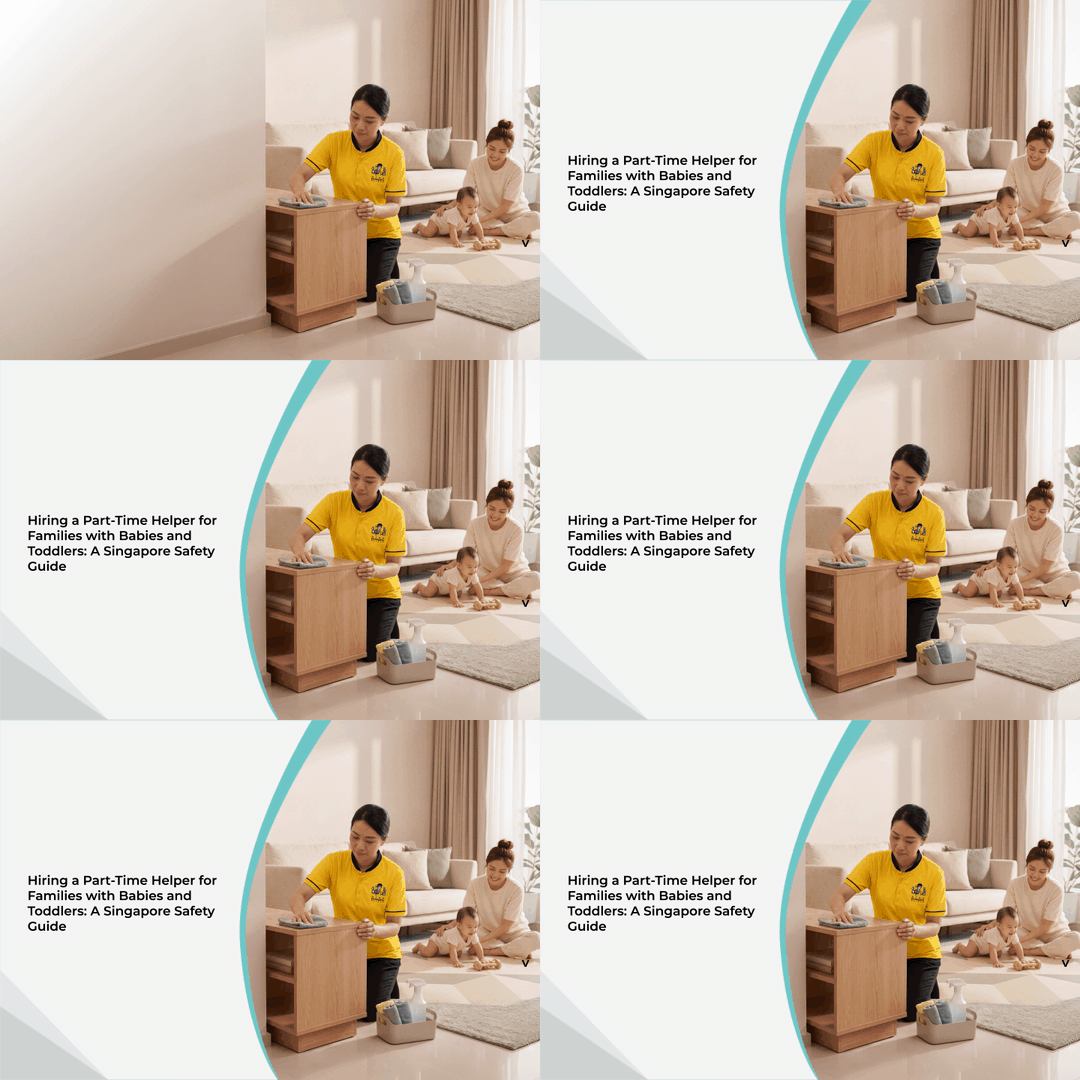
Here is the thing most parents work out only after the first session: the risk in a home clean is not the cleaning. It is the twenty minutes afterwards, when a freshly mopped floor is still damp with something and a nine-month-old is crawling across it with their hands going straight into their mouth.
Babies live at floor level, breathe faster than adults relative to their size, and put everything in their mouths. That combination turns a routine clean into something worth thinking about properly. Not because cleaning is dangerous, but because the same session, done in a slightly different order with two or three products swapped out, is meaningfully safer.
Key Takeaways
- A part-time helper is not a babysitter. Cleaning companies in Singapore, including us, exclude childcare from scope, so plan for a clean that happens around your baby rather than care that replaces you.
- The default supply list is the problem. Most part-time cleaning services ask you to prepare bleach, stain remover, and glass spray, where a household with an infant is better served by unscented, non-aerosol substitutes.
- Sprays and scents carry the most evidence against them. Research following more than 2,000 infants found scented and sprayed cleaning products were associated with the highest risk of wheeze and asthma by age three.
- Timing beats products for practical impact. Booking so that vacuuming and mopping finish at the start of a wake window removes the noise problem and the wet-floor problem in one decision.
- Legal employment is the trust check that matters. Engaging another household's domestic worker part-time is an offence in Singapore for the person paying as much as for the person working.
What Actually Changes When There Is a Baby in the House
Nothing about the cleaning itself is different. What changes is the margin for error.
An adult walks across a mopped floor and nothing happens. An infant crawls across the same floor with their palms flat on it, then puts those palms in their mouth. An adult in a room with a fresh spray of surface cleaner breathes it at chest height for a minute. A baby on a playmat breathes it at floor level, where heavier vapours settle, and does so faster relative to their body size.
Singapore's HealthHub guidance on household poisons makes the same point from the other direction: children are drawn to bright packaging and pleasant smells, which is exactly how cleaning products are designed. A lemon-scented floor cleaner does not read as dangerous to a toddler.
So the adjustments are small and specific. Change a few products. Change the order of the session. Be clear about which items are off-limits. That is most of it.
Which Products to Change When There Is a Baby at Home
"Baby-safe" is not a regulated term in Singapore, so on its own it tells you very little. What is useful is knowing which categories carry the most risk in a home with an infant, and what to use instead.
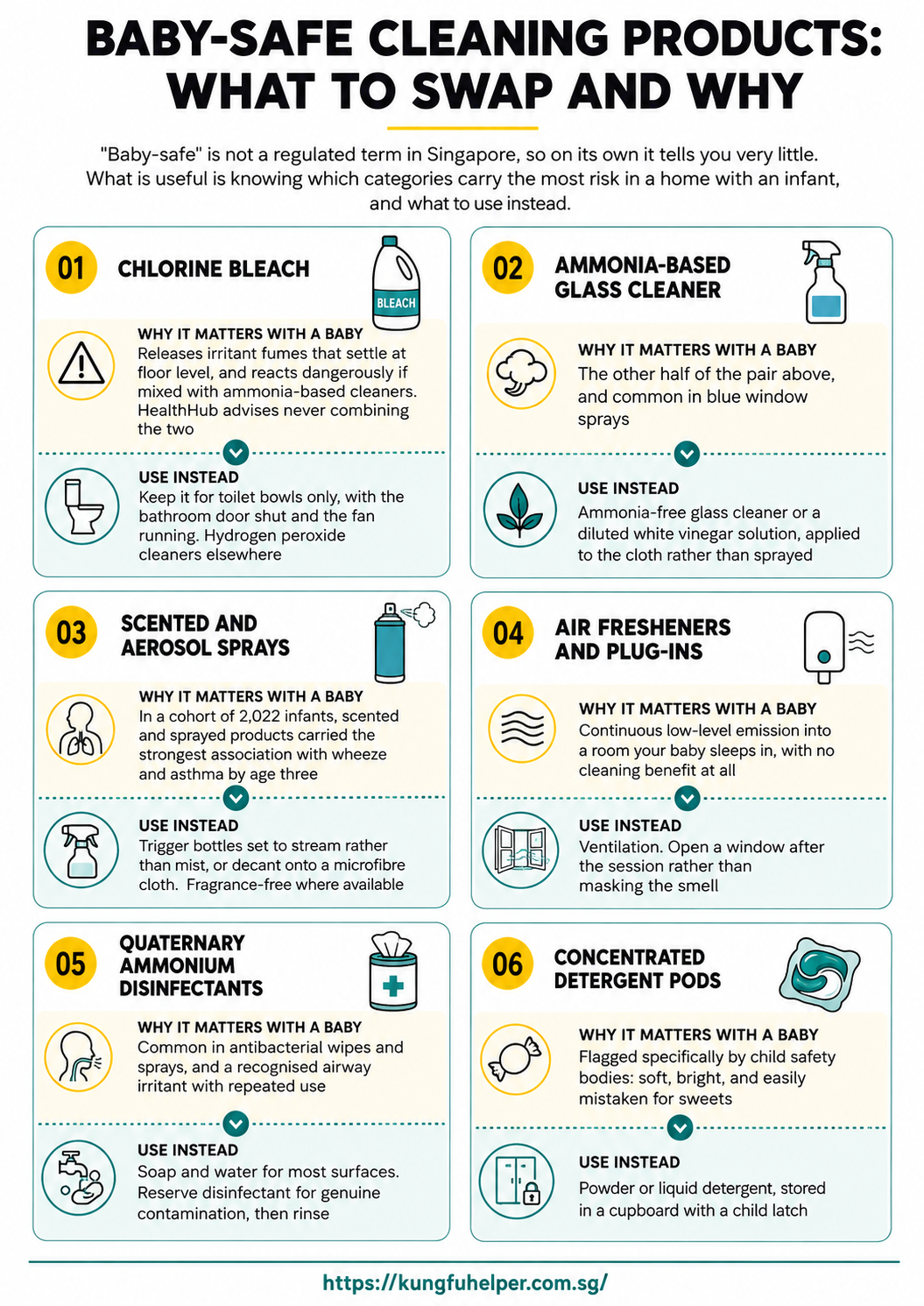
The pattern across all six is the same. The risk is rarely the chemical sitting in the bottle. It is the delivery, meaning whether it becomes an airborne mist, whether it leaves residue on a surface at crawling height, and whether it is stored where small hands reach.
Worth being straight about the limits here: swapping products reduces exposure, it does not eliminate it, and a home cleaned with soap and water is not disinfected. For most households with a healthy baby that is the right trade. If your paediatrician has advised stricter hygiene for a specific reason, follow that instead.
What We Bring, and What You Will Need to Stock
Our part-time helper service runs two ways, and the difference matters more for a household with a baby than for anyone else.
Book at $23 per hour for recurring sessions or $26 per hour ad hoc, and you supply the products. Book with supplies included, and our cleaner arrives with a standard kit.
For a home with an infant we generally suggest the first option, because you control exactly what enters the house. Our standard prepared list includes toilet bowl bleach, bathroom stain remover, kitchen stove cleaner, and window spray. Here is the baby-adjusted version of that list.
| On Our Standard List | Baby-Adjusted Version |
|---|---|
| 1 toilet bowl bleach | Keep it. Toilet bowls only, door closed, fan running, and stored latched afterwards |
| 1 bathroom stain remover | Swap for an unscented hydrogen peroxide or citric acid cleaner |
| 1 window and glass solution | Swap for ammonia-free glass cleaner, or a vinegar solution applied to the cloth |
| 1 kitchen stove cleaner | Keep it, but apply to the cloth rather than spraying, and ventilate the kitchen |
| 1 floor cleaner | Switch to unscented. Plain warm water handles most floors in a home where nobody wears shoes indoors |
| 3 microfibre cloths | Increase to 6 and colour-code them, with one set reserved for the nursery and baby items |
| 1 vacuum | Keep it. If yours has a HEPA filter, mention it, since it changes what gets left behind in the air |
| 1 mop and pail | Add a second small pail kept only for baby items |
The colour-coded cloths are the cheapest improvement on this list by a wide margin. Six microfibre cloths cost a few dollars and remove the main cross-contamination route, which is a cloth that wiped the bathroom later touching a high chair tray.
Scheduling Around Naps
This is the part most parents get wrong on the first booking, and it is the easiest to fix.
Vacuuming is loud. Mopping leaves floors wet for fifteen to thirty minutes. Both are worst during a nap and worst immediately before floor play. The fix is to book so the noisy, wet work happens at the start of a wake window, giving floors the whole nap to dry, and so the quiet work happens while your baby sleeps.
Wake windows, meaning the stretch a baby can comfortably stay awake between sleeps, lengthen quickly across the first two years.
| Age | Typical Wake Window | Naps per Day | What This Means for Booking |
|---|---|---|---|
| 0 to 3 months | 45 to 60 minutes | 4 to 5 | Timing is unpredictable. Book a longer session and accept that it will work around you |
| 3 to 6 months | 1.5 to 2.5 hours | 3 to 4 | A 2.5-hour session fits roughly one wake window plus one nap |
| 6 to 12 months | 2 to 3 hours | 2 to 3 | The easiest stage to plan. Start after the morning wake, with floors done first |
| 12 to 18 months | 3 to 4 hours | 1 to 2 | A 3-hour session fits neatly inside a single wake window |
| 18 months to 3 years | 5 to 6 hours | 1 or none | Book around the single afternoon nap, or during preschool hours |
* These are typical ranges rather than targets. Your baby's own pattern is the one that counts.
A sequence that works for most homes on a 2.5 to 3 hour booking:
- First 30 minutes, wake window. Vacuuming and any floor machine work. This is the loudest part and it needs to happen while your baby is already awake.
- Next 30 minutes, wake window. Mopping, so floors have the entire nap to dry before anyone is back on them.
- Nap begins. Bathrooms, kitchen, dishes, and surface wiping. All quiet, all behind a closed door where possible.
- Final stretch. Bedding, laundry, ironing, and folding. Quiet enough to finish on either side of a wake.
One scheduling note that catches people out: we ask for two days' notice to change a session, otherwise a rescheduling charge of half the booking value applies. With a newborn, book recurring rather than ad hoc, because recurring bookings hold a fixed slot with the same helper, and a fixed slot is far easier to shift within a routine than to rebuild from scratch each week.
Baby Items: What to Tell Your Helper
Assume nothing is obvious. A cleaner who has worked in fifty homes has seen fifty different sets of rules about what may be touched.
Write one page and leave it on the kitchen counter. Cover these:
| Item | What to Say |
|---|---|
| Cot and cot mattress | Whether it gets vacuumed or wiped, and with what. Nothing sprayed directly onto the mattress, and never remade with anything still damp |
| Steriliser, bottles, teats | Off-limits to the general clean. Say so explicitly, because a well-meaning helper may otherwise wash them with dish soap |
| Playmat and floor mats | Warm water and a dedicated cloth. No disinfectant unless you have asked for it, and rinse afterwards if you have |
| High chair | Tray and straps, warm soapy water, rinsed. The straps are the part most often missed |
| Soft toys and comforters | Which ones go in the wash, which never do, and whether the one they sleep with is untouchable |
| Pram and car seat | Usually outside scope, and worth stating rather than leaving to assumption |
| The nursery generally | Whether it is cleaned at all, at which point in the session, and with the door open or shut |
| Nappy bin and changing area | Where the waste goes, and which cloth is used for the changing surface |
Add your building access details, your contact number, and where the cloths and products live. That is the whole document. It takes ten minutes to write once and saves you the same conversation every session.
For the first session we recommend being at home. That is our standard advice for every new client, and it matters more here, because the briefing is longer and you want to see how it goes. Once the routine is set, recurring clients can request the same helper each time, which removes the re-briefing entirely.
Checking Who Comes Into Your Home
Vetting a cleaning company is a different exercise from vetting an individual, and for a home with a baby it is the more useful one. Ask these five questions.
-
1Are your cleaners legally employed, and by whom? This is the single most important question, and the answer should be immediate and specific. Ours are legally employed professionals from Myanmar, engaged through us rather than by you.
-
2Are they background-checked and trained in-house? Ask whether training is internal, or whether the company simply matches you with whoever happens to be available.
-
3Is the company insured, and what does the cover include? Relevant if something is damaged, and more relevant still if someone is injured in your home.
-
4Can I request the same helper each session? Yes. Recurring bookings are assigned the same helper each time. For a household with a baby, this matters because someone who has cleaned your home eight times knows the nursery rules without being told.
-
5What is explicitly excluded from scope? Childcare, elder care, and pet care are all excluded from our part-time helper service. A company that is vague here is a company that has not thought carefully about liability.
The Informal Route
It comes up constantly, usually framed as a favour. A neighbour's domestic worker has Sunday free, she is wonderful with children, and a few hours of help would make an enormous difference.
In Singapore it is illegal, and the exposure is yours as well as hers. A migrant domestic worker's Work Permit ties her to one employer at one declared residential address. Paying her to clean your flat makes you an employer of a foreign worker without a valid pass.
MOM enforces this in practice. In one reported case, an employer was fined $7,000 for engaging a domestic worker already contracted to another household, and the worker was fined $13,000 for taking on unauthorised employment across two homes.
The point is not to alarm. It is that the informal route carries real consequences for a person with considerably less protection than you have, and the legal route costs $23 an hour.
Cleaning that works around your baby's routine
Frequently Asked Questions
Can a part-time helper look after my baby while she cleans?
No. Childcare is excluded from our part-time helper scope, alongside elder care and pet care, and our cleaners are trained and insured for cleaning work. Plan for a clean that happens while you or another caregiver remains responsible for your baby. If you need childcare, engage a separately qualified caregiver for that.
What cleaning products are safest around a baby?
Unscented, non-aerosol products applied to a cloth rather than sprayed into the air. Soap and water handles most surfaces. Keep chlorine bleach for toilet bowls with the door shut and the fan running, avoid ammonia-based glass sprays, and skip air fresheners entirely. Research following more than 2,000 infants found scented and sprayed products carried the strongest association with wheeze and asthma by age three.
When is the best time to book a cleaning session with a newborn at home?
Start at the beginning of a wake window so vacuuming and mopping are finished before the nap, which gives floors time to dry. For a 6 to 12 month old, a mid-morning start usually works well. For toddlers on a single afternoon nap, book either side of it. Recurring bookings hold a fixed slot with the same helper, which is easier to build a routine around.
Is it legal to hire another family's maid for a few hours?
No. A migrant domestic worker may only work for the employer named on her Work Permit, at the declared address. Paying her privately makes you an employer of a foreign worker without a valid pass, which carries fines from $5,000 to $30,000 and possible imprisonment, and she faces separate penalties of her own. Engage through a company whose cleaners are legally employed instead.
How much does a part-time helper cost in Singapore?
KungFu Helper charges $23 per hour for recurring weekly or fortnightly sessions and $26 per hour for ad hoc bookings. The minimum session is 2.5 hours. A 3-room flat of 500 to 750 sqft typically needs 2.5 hours, where a 4-room flat of around 1,000 sqft needs 3 to 4 hours.
The Part Worth Paying For
Most of what makes a clean baby-safe costs nothing. Swap three products, buy six microfibre cloths instead of three, and book the session so the floors dry before your baby is back on them.
The part that does cost something is who you let in. A cleaner engaged through a company that employs her legally, checks her background, trains her in-house, and insures the work is a different proposition from an informal arrangement with someone's helper on her day off. The gap between those two things is about $23 an hour.
For a household running on broken sleep, the real value is not a tidier flat. It is two and a half hours you did not spend cleaning.
Safe cleaning for your family. Book a vetted part-time helper with KungFu Helper.
Book a Part-Time Helper with KungFu Helper
Legally employed, background-checked cleaners, in-house training, and the same helper each session on recurring bookings.
Get a Quote
WhatsApp us on +65 8778 7373 or visit kungfuhelper.com.sg for a rate with no hidden charges.
Confirm Booking
Tell us your home size, your child's age, and your usual nap times so we can size the session and place it in the right slot.
About KungFu Helper
KungFu Helper is a Singapore home services company established in 2017, at 70 Shenton Way, EON Shenton #01-06, Singapore 079118. We specialise in part-time cleaning, house cleaning, post-renovation cleaning, and aircon servicing. We hold a 4.8-star Google rating, and all cleaners are legally employed and background-checked. Childcare, elder care, and pet care are not included in our part-time helper service.
- Ministry of Manpower, reply to media queries on illegal deployment complaints. Financial penalties issued to employers ranged from $3,300 to $24,000 annually. mom.gov.sg
- Ministry of Manpower, A Guide for Migrant Domestic Workers. Illegal deployment and moonlighting penalties. mom.gov.sg
- Parks J et al., association between use of household cleaning products in infancy and childhood wheeze and asthma. CHILD Cohort Study, 2,022 children, CMAJ 2020. pmc.ncbi.nlm.nih.gov
- HealthHub Singapore, Keep Your Home Free From These Safety Hazards. Storage of household chemicals and child poisoning risk. healthhub.sg
- Cleveland Clinic, Wake Windows by Age. Typical wake windows from newborn through toddlerhood. health.clevelandclinic.org
- KungFu Helper, Part Time Helper service rates and prepared supplies list, August 2026. kungfuhelper.com.sg
Disclaimer: This article is general information, not medical advice. It covers cleaning practice in a home with an infant and does not cover infant care, feeding, or safe sleep. For guidance on those, speak to your paediatrician or refer to HealthHub. If you suspect a child has swallowed or been exposed to a cleaning product, call 995 immediately. Pricing shown is KungFu Helper's published rate card as of August 2026 and is subject to change. Regulatory penalties described are current published figures and are summarised for general guidance only. Last updated: August 2026.