
Here's the part that catches people out: a renovated home can look spotless and still have a problem. The dust you can see is the harmless part. Once the debris is swept and the floors are mopped, the room reads as clean, so families move back in.
The particles that matter are the ones you can't see. They're small enough to stay suspended in the air long after the visible mess is gone, and small enough to get past the filter on most household vacuums. If your renovation involved anything more than paint, it's worth understanding what's actually floating around before you unpack.
Key Takeaways
- The danger depends on the work, not the mess. Painting leaves relatively harmless dust, where hacking, tiling, and concrete cutting release respirable silica, which is a different category of risk entirely.
- Invisible particles are the problem. Fine dust below 2.5 microns reaches deep into the lungs, stays airborne for days, and passes straight through most household vacuum filters.
- VOCs peak in the first 72 hours. Formaldehyde and benzene from paints, adhesives, and new carpentry give off the most gas in the first three days and continue for weeks.
- Vulnerable households need longer. Infants, elderly residents, pregnant women, and anyone with asthma or COPD should stay out longer than the general timeline suggests.
- Sweeping makes it worse. Dry sweeping and ordinary vacuuming lift settled dust back into the air. Proper removal needs HEPA filtration and wet-wiping, not agitation.
What's Actually in Renovation Dust
Not all renovation dust is equal. What your contractors did determines what you're breathing.
| Type | Comes from | Why it matters |
|---|---|---|
| Respirable crystalline silica | Hacking, tiling, concrete cutting, masonry | The most serious hazard. Particles lodge deep in the lungs; repeated exposure is linked to permanent scarring and lung disease |
| Cement and masonry dust | Screeding, plastering, wall work | Highly alkaline, meaning strongly caustic in the same way wet cement irritates skin, and irritating to eyes, skin, and airways |
| Wood dust | Cutting and sanding carpentry, flooring | Hardwood dust is treated as more hazardous than softwood; both irritate airways and can trigger asthma |
| VOCs and formaldehyde | Paints, adhesives, sealants, new carpentry and laminates | Gases rather than dust. Cause headaches, nausea, and eye and throat irritation |
| Fine particulates (PM2.5) | All of the above | Small enough to reach the alveoli, the tiny air sacs deep in the lungs, and enter the bloodstream |
For a sense of how seriously these are treated, Singapore's Workplace Safety and Health Regulations set legal exposure limits for workers: 0.1 mg per cubic metre for respirable quartz dust over an 8-hour day, 1 mg for hardwood dust, and 0.3 ppm, meaning parts per million, for formaldehyde over a 15-minute period.
Those limits apply to workplaces, not homes. But they exist because these substances cause measurable harm at low concentrations, and a freshly renovated flat can hold more of them than a regulated worksite would legally permit.
Silica is the one worth taking most seriously. It has no smell, produces no immediate warning symptoms at moderate levels, and the damage from repeated exposure doesn't reverse.
How Long Renovation Dust Lingers
Visible dust settling is not the same as the air being clear. Different particle sizes behave very differently.
| Particle size | Behaviour | Roughly how long |
|---|---|---|
| Visible debris and PM10 | Settles onto surfaces reasonably quickly | 24 to 48 hours with good ventilation |
| PM2.5 (fine particles) | Stays suspended, redistributes when disturbed | Several days to two weeks without active removal |
| VOCs and formaldehyde | Gas, not affected by cleaning | Peaks in first 72 hours, continues giving off gas for weeks |
PM10 means particles under 10 microns across. PM2.5 means particles under 2.5 microns, roughly 30 times thinner than a human hair, which is why you can't see them.
Two things extend this in Singapore specifically. Humidity in the 70% to 90% range slows settling and encourages mould on surfaces that stayed damp during works. And if the aircon ran during renovation, fine dust is now sitting in the coils and ducts, ready to be redistributed through every room the moment you switch it on.
The other issue is re-suspension, which simply means settled dust getting lifted back into the air. Settled dust isn't gone, it's parked. Walking across a floor, dragging furniture, or running a ceiling fan lifts it back into the air. This is why a home can test poorly days after it looked clean.
For context on what "clear" means, the World Health Organization's 2021 air quality guidelines put PM2.5 at 15 micrograms per cubic metre over 24 hours and PM10 at 45. Post-renovation indoor readings commonly sit well above both until the home is properly cleaned and ventilated.
Symptoms of Renovation Dust Exposure
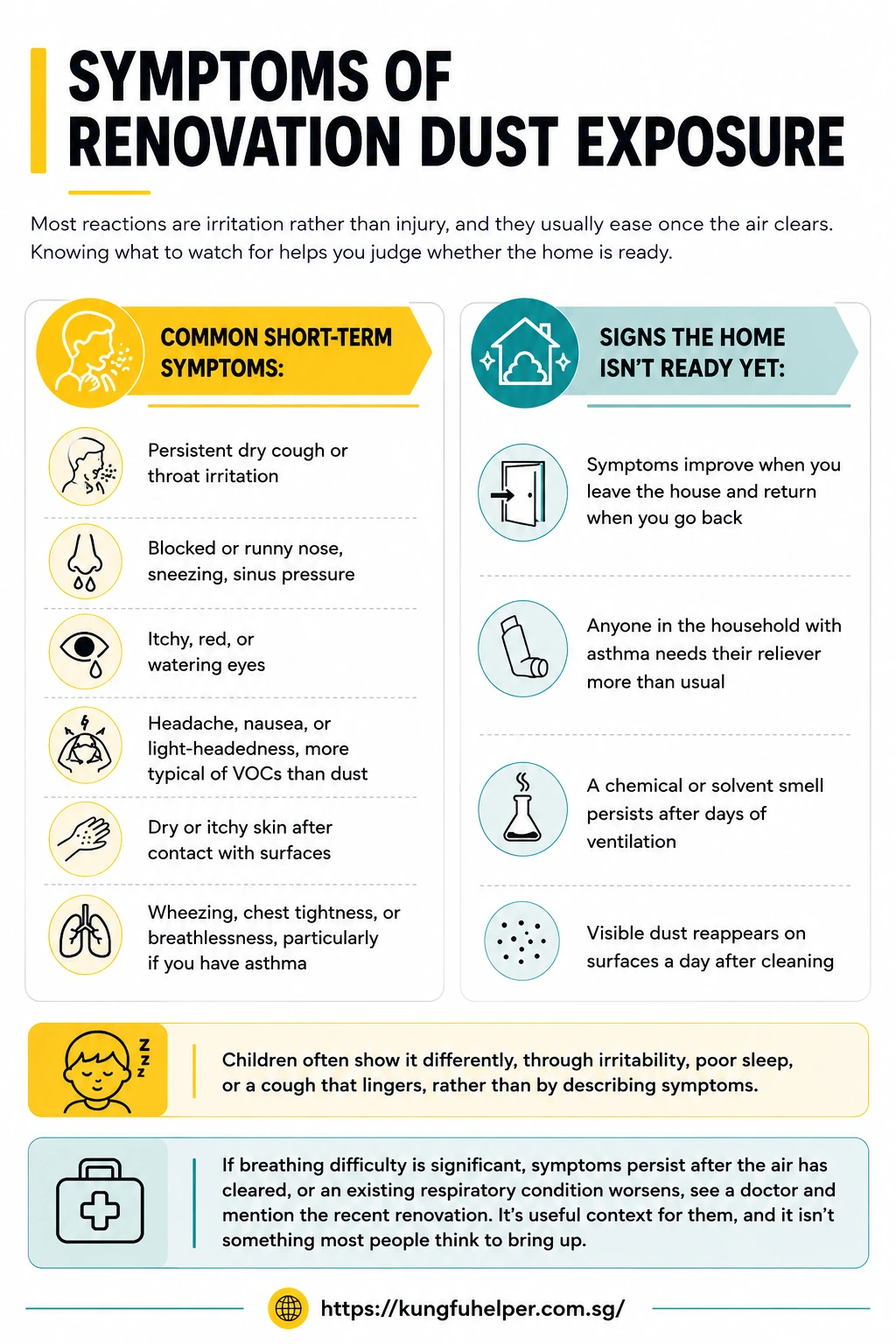
Most reactions are irritation rather than injury, and they usually ease once the air clears. The graphic below covers what to watch for, in adults and in children, who tend to show it through irritability, poor sleep, or a cough that lingers rather than by describing symptoms.
When Is It Safe to Move Back In?
The honest answer is that it depends on what was done and who's moving in.
| Type of work | Suggested wait | What it needs |
|---|---|---|
| Painting, minor fixtures | 24 to 72 hours | Cross-ventilation throughout, aircon filters replaced |
| Flooring, carpentry, partial works | 3 to 7 days | Ventilation plus a thorough clean with proper equipment |
| Hacking, tiling, concrete, full reno | 1 to 2 weeks | Professional post-reno clean, aircon coils cleaned, extended ventilation |
- An infant or young child
- Pregnant
- Elderly
- Living with asthma or COPD
For these households, err toward the longer end of every range and prioritise getting the home cleaned properly rather than waiting it out.
Whatever the timeline, three things matter more than the number of days:
- 1Ventilate properly, not just an open window. Cross-ventilation moving air through and out, ideally with fans assisting.
- 2Deal with the aircon. Replace filters and have the coils cleaned if the unit ran during works, or you'll redistribute everything you just removed.
- 3Clean before you occupy. Moving furniture in first traps dust behind and beneath it, where it stays.
- 4Clean again after moving in. During the move-in we often bring in new dust, dirt, and debris from outside. Another thorough general clean makes sure your home is genuinely move-in ready.
What Professional Cleaning Removes That DIY Leaves Behind
This is where the health argument and the cleaning argument meet. The difference isn't effort, it's whether the method removes fine particles or redistributes them.
- Filtration. Consumer vacuums marketed as HEPA often capture around 85% to 90% of 0.3-micron particles, and many leak around the filter housing. Certified H13 units capture 99.95% in a sealed system, H14 units 99.995%. Below that standard, a vacuum takes fine silica off your floor and returns it to your air.
- Method. Dry sweeping and ordinary vacuuming agitate settled dust back into circulation. Professional post-reno work runs top-down with HEPA filtration followed by wet-wiping, so particles are captured rather than moved.
- The places dust actually hides. Aircon coils and vents, window tracks and sills, cabinet interiors and runners, grout haze, skirting boards, light fittings, and behind built-in carpentry. These are the reservoirs that keep re-contaminating a room, and they're the ones a visual clean misses.
- Protection during the work. Whoever cleans is exposed to the highest concentrations. If you are doing this yourself, a surgical or cloth mask offers little protection against fine silica, and a properly fitted N95 or P100 respirator is worth the outlay.
Don't move back into a dusty home
Let KungFu Helper clear the air first.
Frequently Asked Questions
Can renovation dust cause breathing problems?
It can cause coughing, throat irritation, wheezing, and chest tightness, and it commonly worsens existing asthma. Most symptoms ease once the air clears. If breathing difficulty is significant or symptoms persist, see a doctor and mention the recent renovation.
Is renovation dust dangerous for babies and children?
Children breathe faster relative to their size and spend more time on floors where dust settles, so they're more exposed than adults in the same room. For households with infants or young children, wait longer than the general timeline and get the home professionally cleaned before moving back.
How long should I wait before moving in after renovation?
For painting and minor work, 24 to 72 hours of proper ventilation. For flooring and carpentry, 3 to 7 days plus a thorough clean. After hacking, tiling, or a full renovation, allow one to two weeks with a professional clean. Extend all of these if infants, elderly, pregnant, or asthmatic residents are moving in.
Do I need to clean my aircon after renovation?
Almost always, if the work created heavy dust or the unit ran during renovation. Fine particles settle into the coils and filters, and switching the unit on afterwards distributes that dust through every room. Our aircon cleaning service can be arranged alongside a post-reno clean.
Will an air purifier remove renovation dust?
A HEPA air purifier helps with what's airborne and is worth running for several days after cleaning. It won't remove dust already settled in tracks, coils, and cabinet interiors, which is where the reservoirs sit. Purifiers work best alongside a proper clean, not instead of one.
The Bottom Line
Renovation dust is dangerous in proportion to what created it. Paint-only work leaves a mess. Hacking, tiling, and concrete work leave fine silica that a household vacuum will circulate rather than capture, and that's a health question rather than a housekeeping one.
The safest approach isn't complicated. Ventilate properly, deal with your aircon, get the home cleaned with equipment that captures fine particles instead of redistributing them, and give it longer if anyone moving in is very young, elderly, pregnant, or asthmatic.
Don't move back into a dusty home. Let KungFu Helper clear the air first.
Book Post-Renovation Cleaning with KungFu Helper
Multi-stage process, HEPA filtration, and cleaners who are legally employed and background-checked.
Get a Quote
WhatsApp us or visit kungfuhelper.com.sg for an itemised quote.
Confirm Booking
Tell us your floor area and what the renovation involved so we can size the team and equipment correctly.
About KungFu Helper
KungFu Helper is a Singapore home services company established in 2017, at 70 Shenton Way, EON Shenton #01-06, Singapore 079118. We specialise in post-renovation cleaning, part-time cleaning, move-in/move-out cleaning, and aircon servicing. We hold a 4.8-star Google rating across 447+ verified reviews, and all cleaners are legally employed and background-checked.
Disclaimer: This article is general information, not medical advice. If you or a family member develop breathing difficulties or persistent symptoms after a renovation, consult a doctor. Re-entry timelines are guidance based on typical residential renovation work and vary with scope, ventilation, and household health needs. Last updated: July 2026.
- Workplace Safety and Health (General Provisions) Regulations, First Schedule: Permissible Exposure Levels of Toxic Substances. Singapore Statutes Online. Quartz respirable dust 0.1 mg/m³ long term, hardwood dust 1 mg/m³, softwood dust 5 mg/m³, formaldehyde 0.3 ppm short term, benzene 1 ppm long term.
https://sso.agc.gov.sg/SL/WSHA2006-RG1?ProvIds=Sc1- - World Health Organization, Global Air Quality Guidelines 2021. PM2.5 at 5 micrograms per cubic metre annual mean and 15 over 24 hours; PM10 at 15 annual and 45 over 24 hours.
- EN 1822, European standard for HEPA filter classification. H13 at 99.95% and H14 at 99.995% at the most penetrating particle size.