
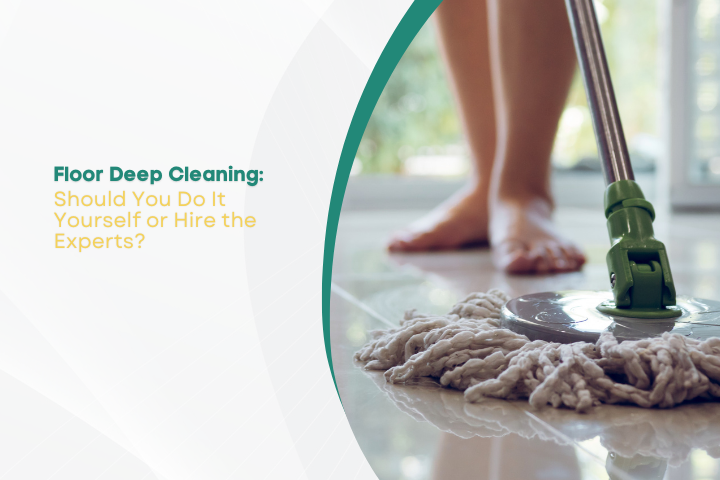
Our floors bear the brunt of our daily routines. Regular mopping can help maintain their general cleanliness, but floor deep cleaning is the best way to protect this investment and maintain a healthy home space.
This guide will help you understand your flooring needs so you can make informed decisions about proper floor maintenance.
Why Floor Deep Cleaning Matters More Than You Think
Floor deep cleaning goes far beyond what your regular mop and bucket can achieve. With average humidity levels hovering around 84%, your floors can be greatly affected too.
Health and Hygiene
High humidity promotes the growth of dust mites, mould and bacteria. They can accumulate on floors and may cause respiratory issues and allergies in family members.
Deep cleaning targets germs and allergens, which improves indoor air quality (IAQ) and reduces health risks.
Protecting & Maintaining Floors
Sticking to surface cleaning instead of performing deep cleaning risks permanent floor damage. The embedded dirt and grime are not tackled, shortening the lifespan of your flooring materials.
Understand Your Floor Type
Ceramic and Porcelain Tiles
Ceramic and porcelain tiles require specific care.
These tiles are porous, meaning they absorb liquids and stains over time. What makes cleaning more challenging is the grout lines which can soak up liquid spills and moisture.
Marble and Natural Stone
Marble flooring is popular in condominiums and landed properties. And it also requires sensitive care.
Marble reacts violently to acidic cleaners with a pH sensitivity range of 0-6.9. Even seemingly harmless vinegar can cause permanent etching.
The calcium carbonate in natural stone makes it vulnerable to slightly acidic rain (pH 4.2-4.5) tracked in on shoes.
Vinyl and Laminate
Vinyl and laminate flooring also increased in popularity. Even if they are marketed as low-maintenance, they require more careful cleaning.
Vinyl’s plasticizers, or the chemicals that keep it flexible, break down under harsh cleaners, resulting in brittleness and cracking. Laminate’s fibreboard core swells irreversibly when exposed to excess moisture.
Deep cleaning these surfaces requires controlled moisture application and neutral pH cleaners.
Parquet and Hardwood
Parquet flooring remains popular for its classic, elegant look and durability. However, it requires more maintenance due to the humid climate.
Wood’s hygroscopic nature means it constantly absorbs and releases moisture, causing movement that loosens individual pieces. The traditional adhesives used in older installations often fail under prolonged humidity exposure.
When DIY Makes Sense
DIY cleaning works for regular maintenance between professional sessions.
Weekly mopping with pH-neutral cleaners, immediate spill cleanup, and monthly grout brushing can extend the time between deep cleans.
For vinyl and laminate, bi-weekly damp mopping with manufacturer-approved cleaners maintains appearance adequately.
However, DIY has strict limitations. Household equipment lacks the pressure and heat necessary for floor deep cleaning.
More importantly, without proper knowledge, DIY attempts usually cause irreversible damage.
Critical Mistakes That Can Be Costly
Common DIY disasters can include:
- Marble etching from toilet bowl cleaners
- Replacement cost: S$10-40 per square foot
- Parquet warping from steam mops
- Refinishing cost: S$3-8
- Grout deterioration from the overuse of bleach
- Re-grouting cost: ~S$10 per square foot
Professional Floor Deep Cleaning
Professional deep cleaning follows a systematic process.
First, technicians test your floor’s pH and porosity so they can select appropriate chemicals. Then they pre-treat the floor by applying emulsifiers that break down buildup at the molecular level.
The main cleaning involves the use of truck-mounted or portable extraction units generating heat and pressure impossible to achieve with consumer equipment.
For tiles, professionals use rotary machines with specialised brushes that clean grout lines 3-4 mm deep.
Marble receives diamond pad treatment progressing through multiple grits.
Wood floors undergo controlled sanding with dust containment systems, followed by multiple seal coats.
The entire process includes edge detail work, corner cleaning, and protective sealer application.
What You’re Really Paying For
More than comprehensive cleanliness, professional services provide the following:
- Many flooring manufacturers void warranties if you cannot prove professional maintenance.
- Professionals carry liability coverage for accidental damage.
- HEPA-filtered extraction removes allergens and pathogens.
- Chemicals and wastewater are disposed of according to NEA regulations.
- Technicians undergo extensive hours of training on flooring types and chemistry.
Professional Grout Sealing
Professional-grade sealers are formulated for deeper penetration and create a hydrophobic barrier that can last for several years.
Grout sealing prevents staining and reduces cleaning by as much as 60%. The application requires specific temperature and humidity conditions, plus specialised equipment for even distribution and proper curing.
Cost Analysis
DIY
The initial costs of going DIY can be enticing, unless you factor in the following:
- Equipment rental for effective cleaning
- Multiple product purchases for different floors
- Potential damage repairs
- Physical strain and risk of injury
- Repeated efforts due to inadequate results
Professional Service
Professional floor deep cleaning costs can range from S$300 up to S$1,000, depending on the area size.
This already includes labour, equipment, chemicals, and guaranteed results.
Making Your Decision
Partnering with Professionals
Choose professional service when:
- Your floors have not been deep cleaned in 12+ months
- Visible staining or discolouration persists after regular cleaning
- Grout line appear dark or mouldy
- Moving in/out of a property
- Preparing for special occasions
- Dealing with marble, natural stone, or antique wood
- Health concerns require thorough sanitisation
- Time is more valuable than money
- You lack confidence in proper techniques
What to Look For in Floor Deep Cleaning Service Providers
Legitimate professionals should provide:
- BizSafe certification
- NEA compliance
- Clear quotations
- Before and after documentation
- Service guarantee
- Transparent processes
Red Flags to Avoid
- Prices are significantly below market
- No physical address or company registration
- Demands for full upfront payment
- Unwillingness to provide references
- Vague service descriptions
- High-pressure same-day signing tactics
Your Next Steps
If your floors need attention now, start by identifying your flooring type and measuring the area.
Request quotes from 3-4 established companies, comparing the price, service scope, products used, and guarantees offered. Ask specific questions about their process for your floor type.
Schedule service during dry weather when possible to allow optimal curing conditions for sealers. Prepare by removing furniture and personal items.
Plan for 4-6 hours of service time and 2-4 hours of drying time.
Establishing a Maintenance Schedule
For high-traffic areas (like the living room and kitchen): professional cleaning every 6 months.
For moderate-traffic areas such as bedrooms: annual professional service
For low-traffic areas like store rooms: Every 18-24 months
Special surfaces (marble, parquet): Quarterly professional maintenance
Conclusion
DIY maintenance has its place in regular upkeep. However, professional floor deep cleaning provides value impossible to replicate with household methods.
The expertise, equipment, and guaranteed results justify the investment.
So don’t wait for visible damage to appear. Proactive professional maintenance costs far less than active repairs. Contact flooring services for immediate and tailored solutions for your floors.